
- Email us at
[email protected] - Questions? Give us a call
503-773-6949

Safe Utility Potholing – Vacuum Excavation in Tigard, OR
Accurate Subsurface Utility Exposure in Washington County’s Tualatin Valley Corridor
Tigard sits in the Tualatin Valley, defined by heavy clay that challenges every excavation project. Beneath roads serving 58,000 residents, gas mains follow OR-99W, water branches across Bull Mountain, and telecom threads through the Tigard Triangle. Prodan Construction provides utility potholing and vacuum excavation throughout Tigard, exposing buried lines in clay that shifts from brick-hard in summer to adhesive mud after fall rains.
- Licensed Oregon contractor — CCB #176278 — fully bonded and insured
- Non-destructive vacuum excavation protects gas, water, electric, and telecom lines
- Serving all Tigard neighborhoods from Damascus, about 30 minutes via I-205 and I-5
What Is Utility Potholing?
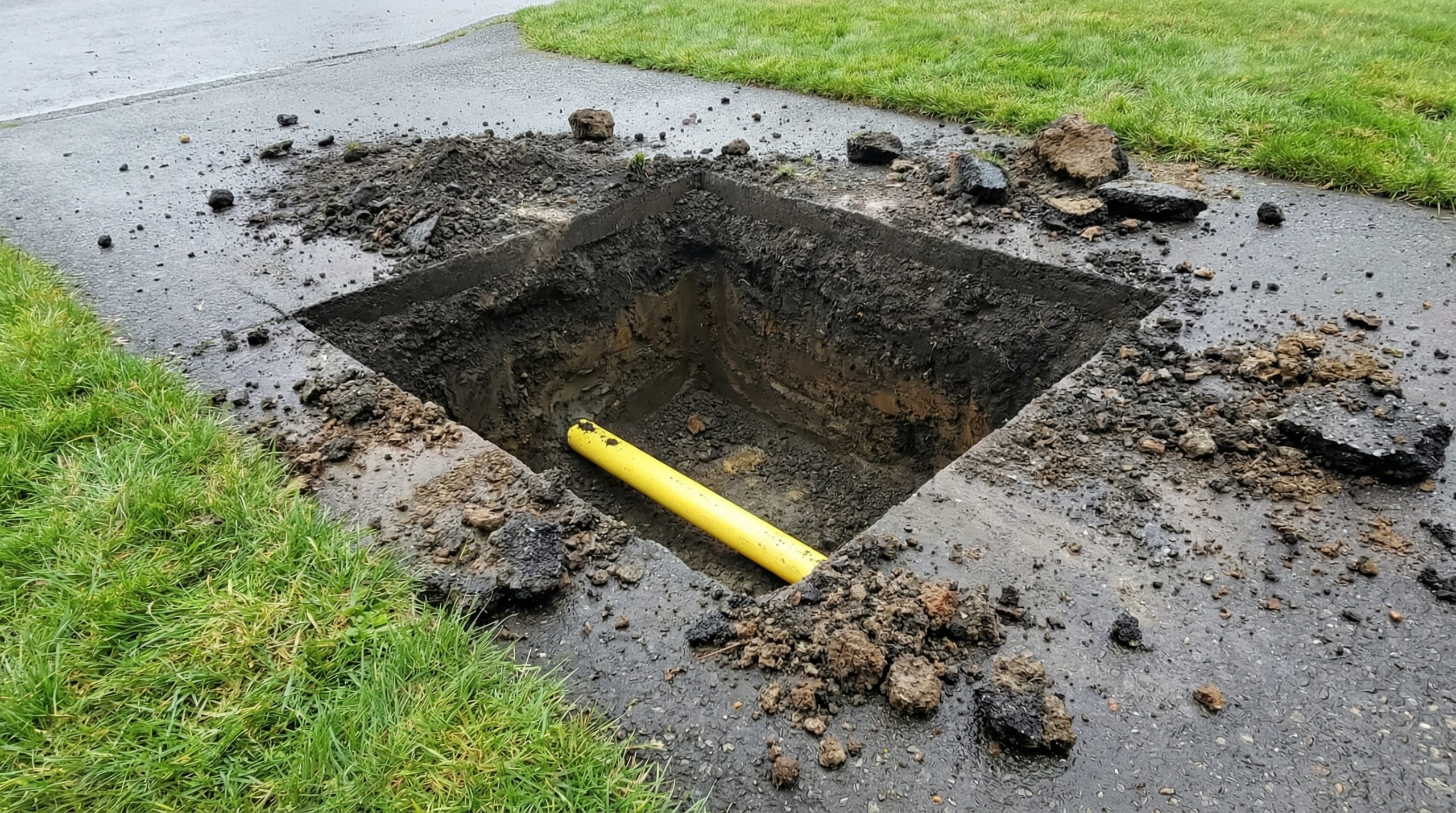
Utility potholing opens a small, controlled window into the ground to confirm where buried infrastructure runs. Vacuum extraction lifts soil under suction rather than scraping with a bucket. In Tigard, where sticky valley clay grips pipes tightly, this prevents strikes along Hall Boulevard and Scholls Ferry Road.
Soft digging employs pressurized water (hydro excavation) or compressed air to loosen material before vacuum removal. Hydro excavation breaks through Tigard’s dense valley-floor clay efficiently, especially near Cook Park where alluvial deposits mix with compacted silt. Air excavation is safer near fiber optic junctions and energized conduit because compressed air cannot carry current.
For Tigard contractors, potholing delivers ground truth that surface locate marks cannot guarantee. Whether installing storm drainage near Fanno Creek, routing gas service on Bull Mountain, or connecting water laterals along Durham Road, verified utility depths eliminate guesswork. Washington County permitting increasingly expects subsurface verification within congested corridors.
Potholing vs. Daylighting Utilities: What Tigard Contractors Need to Know
Both terms describe non-destructive excavation, but they address different project requirements. The right choice depends on whether you need to confirm a single water main crossing beneath Bonita Road or reveal an entire utility corridor for the Tigard Triangle mixed-use development.
1. Targeted Utility Potholing
Targeted potholing excavates a compact opening — twelve to eighteen inches across — directly above a suspected utility to confirm depth, material, and alignment. We frequently perform this ahead of directional boring where a drill path must clear water and sewer mains under Pacific Highway. A single test hole in Tigard’s clay typically completes in under an hour.
2. Utility Daylighting
Daylighting uncovers a longer stretch of buried pipe for inspection, repair, or connection work. Tigard’s older neighborhoods between Downtown and Metzger contain water service from the 1970s and 1980s that needs evaluation before adjacent construction. Our vacuum method reveals the complete pipe circumference without vibration that could weaken aging joints.
The Benefits of Non-Destructive Excavation
Underground utility strikes generate costly consequences — from emergency shutoffs affecting Tigard businesses along 99W to repair bills that dwarf project budgets. Vacuum excavation eliminates the primary failure mode: direct mechanical impact on buried infrastructure.
1. Damage Prevention & Safety
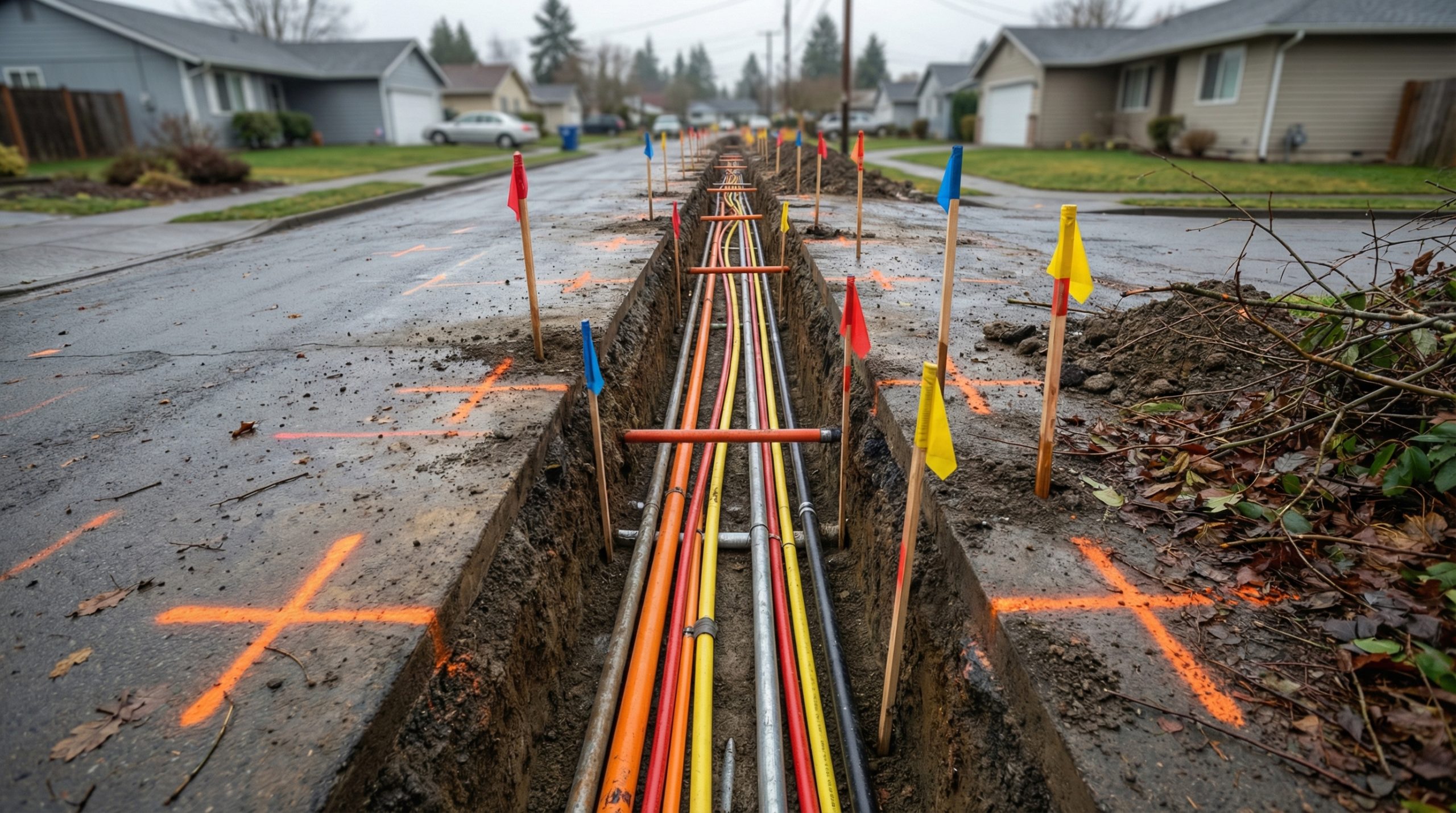
A typical Tigard street carries gas, water, sewer, and fiber within a few feet of vertical separation. On Bull Mountain, these utilities run through weathered basalt that conceals depth changes. Vacuum extraction removes material grain by grain, giving operators real-time visibility. For crews in the corridor between I-5 and OR-217, this is the only approach that genuinely prevents cross-bore incidents.
2. Cost Savings
A ruptured gas line triggers evacuation, fire response, emergency repair, and fines — expenses that can exceed the entire original project cost. A verification pothole costs a fraction of even a minor strike repair. For subdivision developers platting lots near Summerlake or East Bull Mountain, potholing is essential financial protection.
3. Precision in Tight Spaces
The Tigard Triangle’s mixed-use zoning pushes buildings close together with shared utility easements. Downtown revitalization projects involve trenching within feet of existing storefronts. Our flexible vacuum hose extensions reach between foundation walls and through gaps that rigid equipment cannot access, making verification practical in Tigard’s most constrained sites.
Our Vacuum Excavation Equipment and Methods
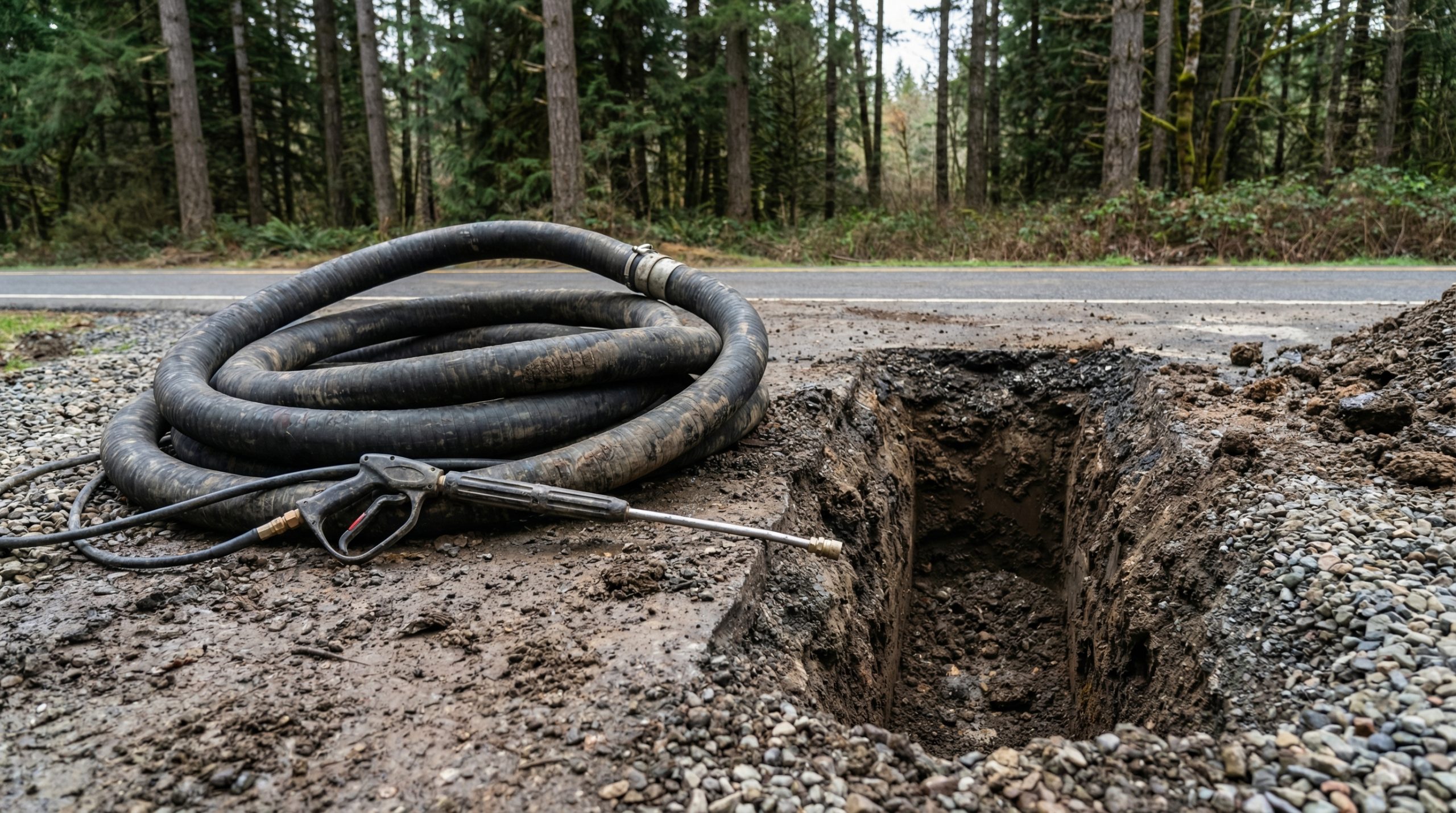
Our truck-mounted vacuum systems produce over 5,000 CFM of suction paired with adjustable-pressure water jets. In Tigard’s valley-floor clay, higher jet pressure breaks the adhesive soil matrix; on Bull Mountain’s weathered basalt, rotary nozzles fragment harder material. Each unit carries a self-contained spoil tank, eliminating loose debris on residential streets.
Specialized extension wands and narrow nozzles allow precise work at depth. When potholing beneath Scholls Ferry Road or along a Fanno Creek Trail crossing, our equipment accesses the target through a compact surface opening, keeping traffic lanes open and minimizing disruption to pedestrian paths.
Our Utility Exposure Process
Every Tigard potholing engagement follows a structured four-step workflow producing reliable, documented results under strict safety protocols.
Step 1: Site Assessment & Locating
We review OUNC locate markings, as-built drawings, and municipal GIS records. Electromagnetic and GPR scanning supplements surface marks. Tigard’s clay retains moisture unevenly, distorting signal propagation — our crews compensate with multi-frequency sweeps, particularly in the Fanno Creek lowlands where the water table rises within feet of grade during winter.
Step 2: Safe Excavation
Test holes are opened using hydro or air methods matched to ground conditions. In the dense Willamette-series silt loam blanketing the valley floor, moderate water pressure disaggregates clay without displacing utility bedding. Where Bull Mountain’s volcanic substrate appears, we increase pressure and switch to rotary tips. Continuous vacuum extraction keeps the hole clear for visual monitoring.
Step 3: Verification
Each exposed utility is measured — depth, horizontal offset, material, diameter, and condition. Photographs and GPS coordinates compile into a pothole report that integrates with civil engineering plans and GIS databases maintained by Washington County and the City of Tigard.
Step 4: Backfilling & Site Cleanup
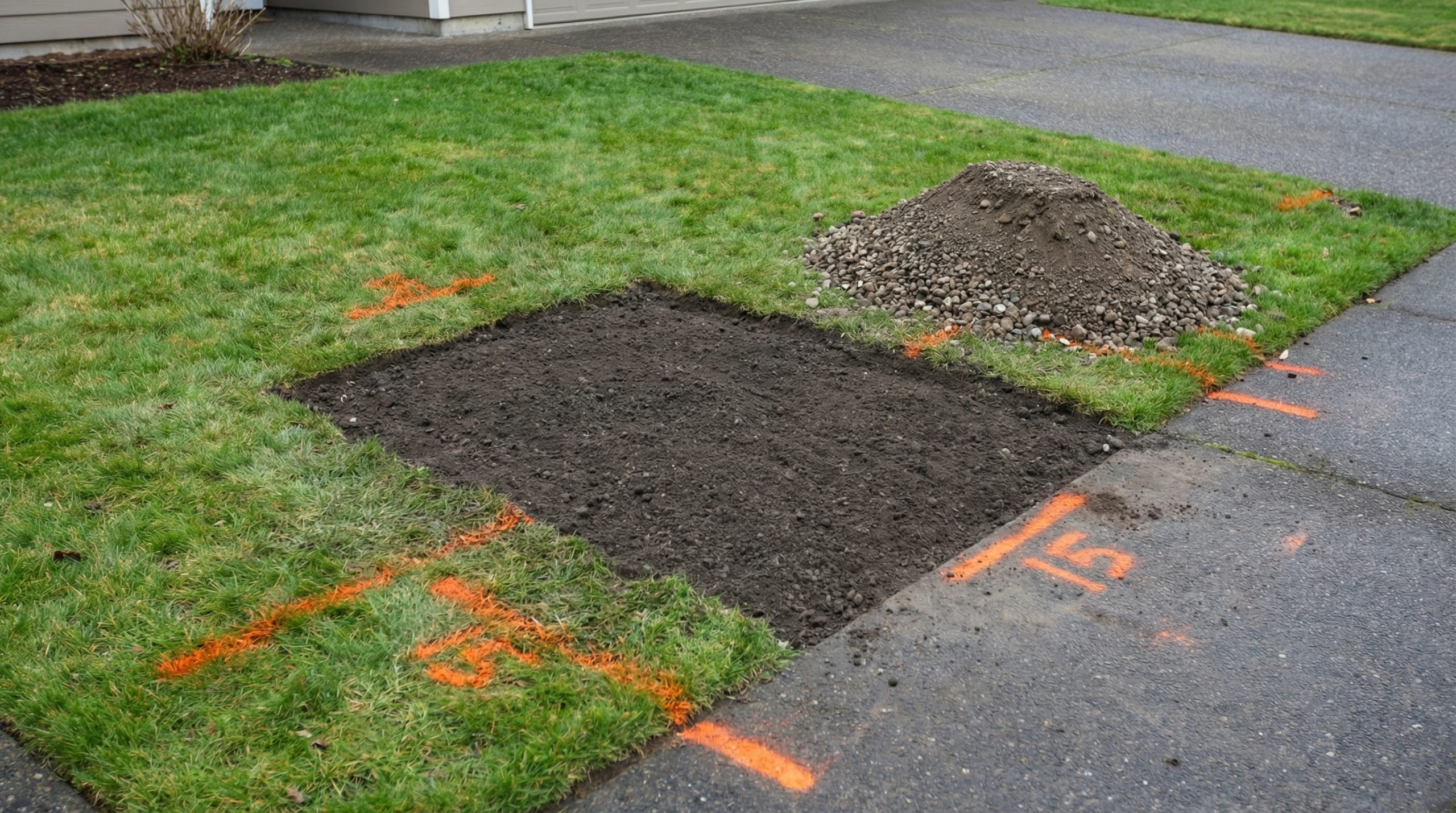
Backfill proceeds in controlled lifts using screened material or approved fill. Paved surfaces receive cold patch or coordinated asphalt restoration. Every Tigard job site is returned clean — no spoil piles, no open cavities, no equipment tracks on adjacent lawns.
Trusted Excavation Experts in Tigard
Prodan Construction LLC (CCB #176278) works with general contractors, civil engineers, utility providers, and residential developers throughout Tigard. Beyond potholing, we provide demolition, land clearing, and retaining wall construction — a single-source contractor for complete site preparation.
Based in Damascus, we reach Tigard in roughly thirty minutes via I-205 and I-5. Our operators know every soil condition from the Fanno Creek wetlands to Bull Mountain’s volcanic ridgeline. When your Tigard project demands verified utility positions, contact Prodan Construction.
Frequently Asked Questions About Potholing & Soft Digging in Tigard
Why is potholing especially important in Tigard’s clay soils?
Tualatin Valley clay expands and contracts with moisture changes, gradually shifting utility positions from their original as-built locations. Pipes installed decades ago may have moved several inches. Potholing confirms actual current depth and alignment, which surface locating cannot guarantee in clay-dominant ground.
Can you pothole near Fanno Creek where the water table is high?
Yes. Our vacuum units handle saturated soil effectively. Water entering the hole is extracted along with loosened material, maintaining visibility. In Fanno Creek corridor sites where groundwater sits within three to four feet of grade during winter, we adjust technique to prevent sidewall collapse and ensure accurate measurement.
Do you work in the Tigard Triangle redevelopment area?
Absolutely. The Tigard Triangle between I-5, OR-99W, and OR-217 is undergoing significant mixed-use densification requiring extensive utility verification. Existing infrastructure was designed for lower-density commercial use. We regularly pothole for developers confirming capacity and routing before new construction.
How quickly can you mobilize to a Tigard job site?
Standard scheduling places our crew on site within one to three business days. Emergency potholing can often be arranged within twenty-four hours. Call us at (503) 773-6949 to discuss your timeline.
Schedule Your Utility Potholing Service in Tigard Today
Tigard’s growth — from subdivisions climbing Bull Mountain to the Tigard Triangle’s transformation — places increasing demand on underground utilities. Whether extending service near Summerlake, verifying sewer depth along Pacific Highway, or confirming gas clearance on Hall Boulevard, Prodan Construction provides the subsurface certainty your project requires.
Call us at (503) 773-6949 or send us a message to request your free utility potholing estimate in Tigard.
Quick Links
Services
Contact Us
- Address:
20500 SE Hwy 212, Damascus, OR 97089 - Phone:
503-773-6949 - Email:
[email protected]

Oregon CCB # 176278