
- Email us at
[email protected] - Questions? Give us a call
503-773-6949
Safe Utility Potholing – Vacuum Excavation in West Linn, OR
Non-Destructive Utility Location for the City of Hills, Trees and Rivers
West Linn packs dramatic topography into just 7.4 square miles — steep hillsides carved from Columbia River Basalt and Boring Lava formations, river bluffs dropping hundreds of feet to the Willamette and Tualatin, and landslide-prone slopes where saturated clay meets impervious rock. Beneath this terrain lies a utility network serving 27,600 residents, routed through some of the most geologically challenging ground in the Portland metro area.
- Licensed Oregon contractor — CCB #176278 — fully bonded and insured
- Non-destructive vacuum excavation protects gas, water, electric, and telecom lines
- Operating from Damascus, roughly twenty minutes from West Linn via I-205
What Is Utility Potholing?
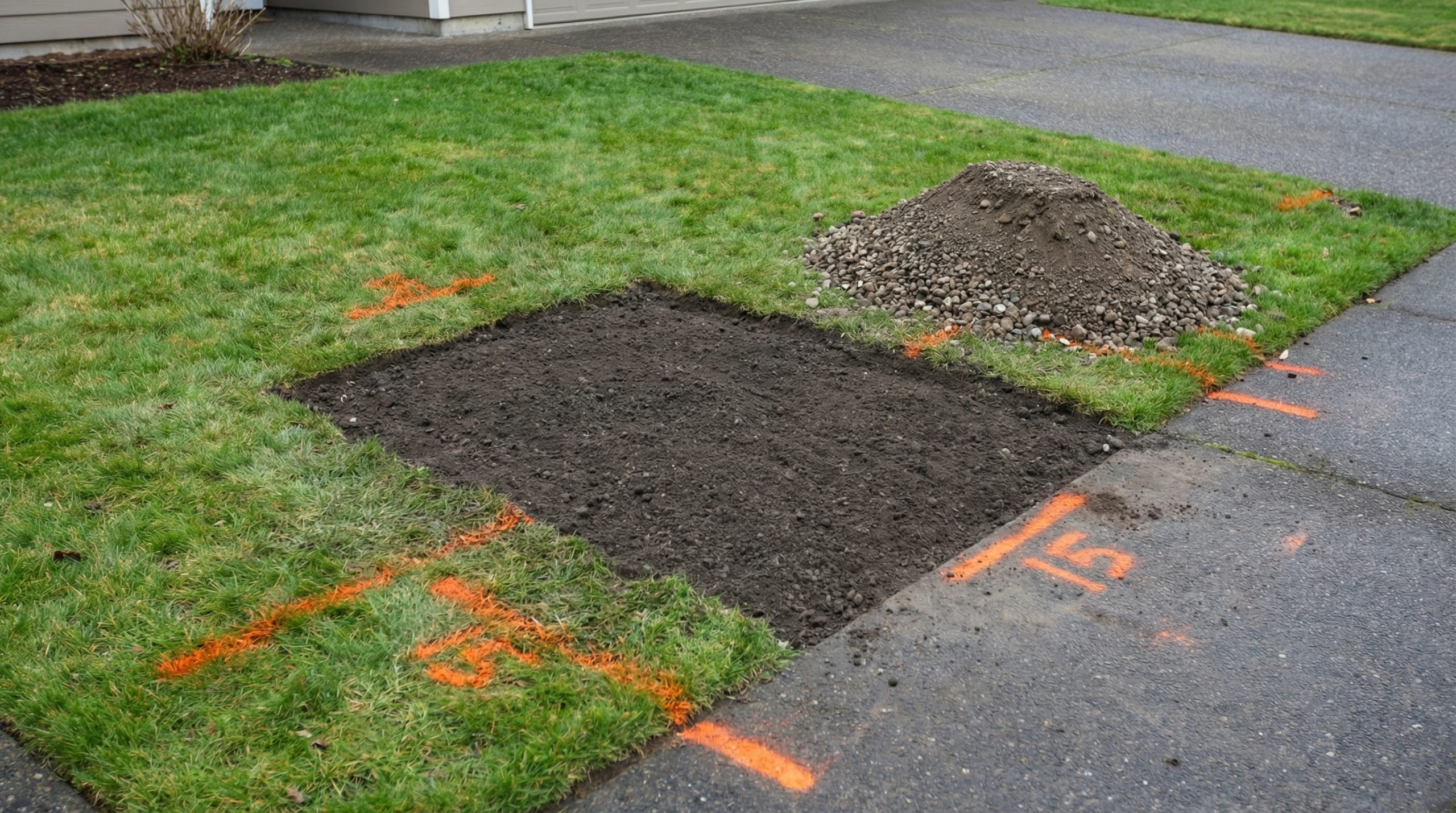
Utility potholing opens a small, located hole to physically expose a buried utility so it can be seen, measured, and documented. Vacuum extraction — not a backhoe bucket — removes the surrounding soil, ensuring that no mechanical force touches the pipe or conduit below.
Soft digging relies on two soil-loosening techniques paired with continuous vacuum removal. Hydro excavation directs a focused water stream to break apart West Linn’s heavy basalt-derived clay, which can be nearly impenetrable with hand tools after a dry summer.
For contractors on West Linn’s hillside lots or remodeling in Bolton and Robinwood, potholing resolves uncertainty surface locating cannot address. Utilities follow steep grades with depth varying dramatically over short distances — a gas line at three feet uphill may sit eight feet deep at the downhill boundary.
Potholing vs. Daylighting Utilities: What You Need to Know
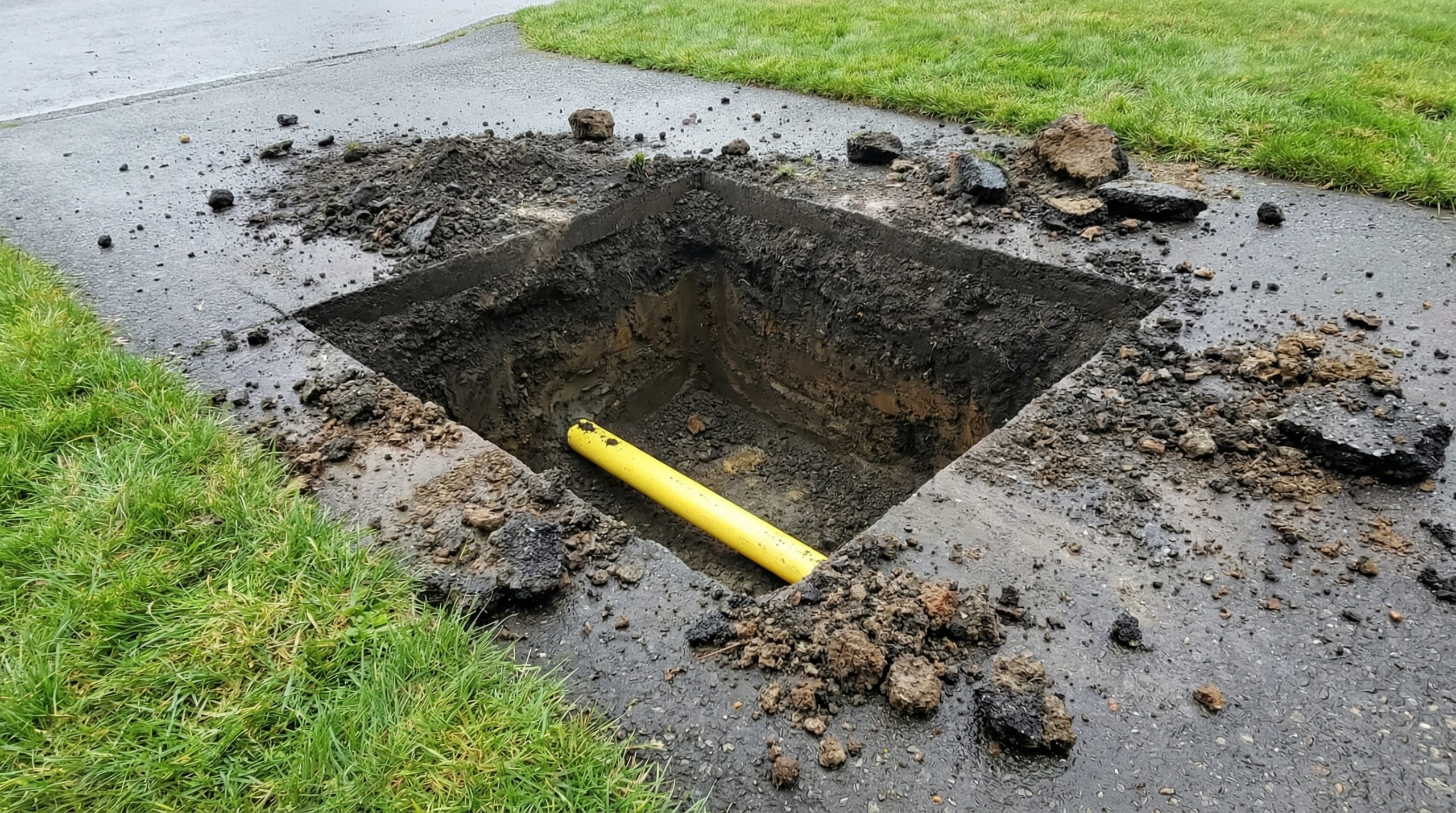
West Linn projects regularly call for one or both techniques. The deciding factor is whether you need a single confirmation point — verifying a gas-line crossing before a retaining-wall footing pour — or a continuous exposure to inspect an aging sewer lateral running down a hillside to the trunk main below.
1. Targeted Utility Potholing
Targeted potholing produces a compact twelve-to-eighteen-inch opening over the suspected utility location, confirming depth, material, and alignment at that specific point. On West Linn’s steep lots, even a single pothole must account for slope angle — the utility’s depth relative to the uphill surface differs from its depth at the downhill face of the hole.
2. Utility Daylighting
Daylighting reveals an extended section of buried utility for thorough inspection or connection work. In the Sunset and Cedaroak neighborhoods, where sewer laterals descend steep terrain to reach collector mains, daylighting exposes the pipe’s full profile across multiple grade changes.
The Benefits of Non-Destructive Excavation
West Linn’s geology amplifies the consequences of every underground utility strike. A broken pipe on a hillside introduces water into clay soils already prone to saturation-triggered landslides.
1. Damage Prevention & Safety
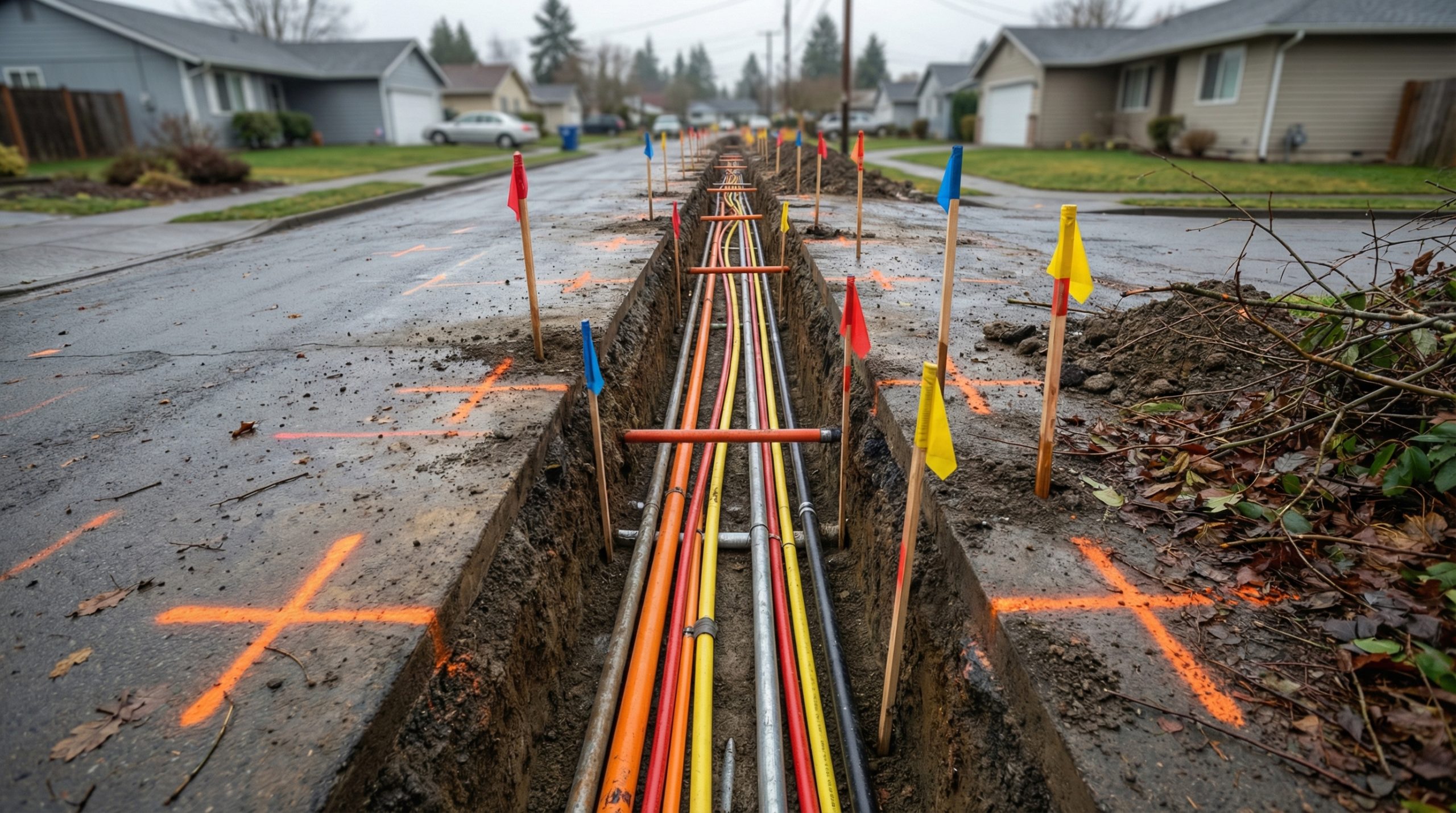
A typical West Linn hillside lot carries utilities with depth changes that surprise experienced excavators. A water main may run inches from a sewer lateral at one elevation, then diverge by several feet at another. Vacuum excavation peels away clay and basalt without shock or vibration.
2. Cost Savings
A ruptured gas main on a West Linn hillside with one access road forces neighborhood evacuation with no detour. Emergency costs, fines, and delays accumulate quickly. A pre-dig pothole eliminates the risk at a fraction of the expense.
3. Precision in Tight Spaces
West Linn’s residential lots are defined by steep grades, mature Douglas fir canopy, and retaining walls that segment properties into terraced building pads. Standard excavation equipment cannot safely operate on many of these sites without extensive temporary grading that itself risks destabilizing the slope.
Our Vacuum Excavation Equipment and Methods
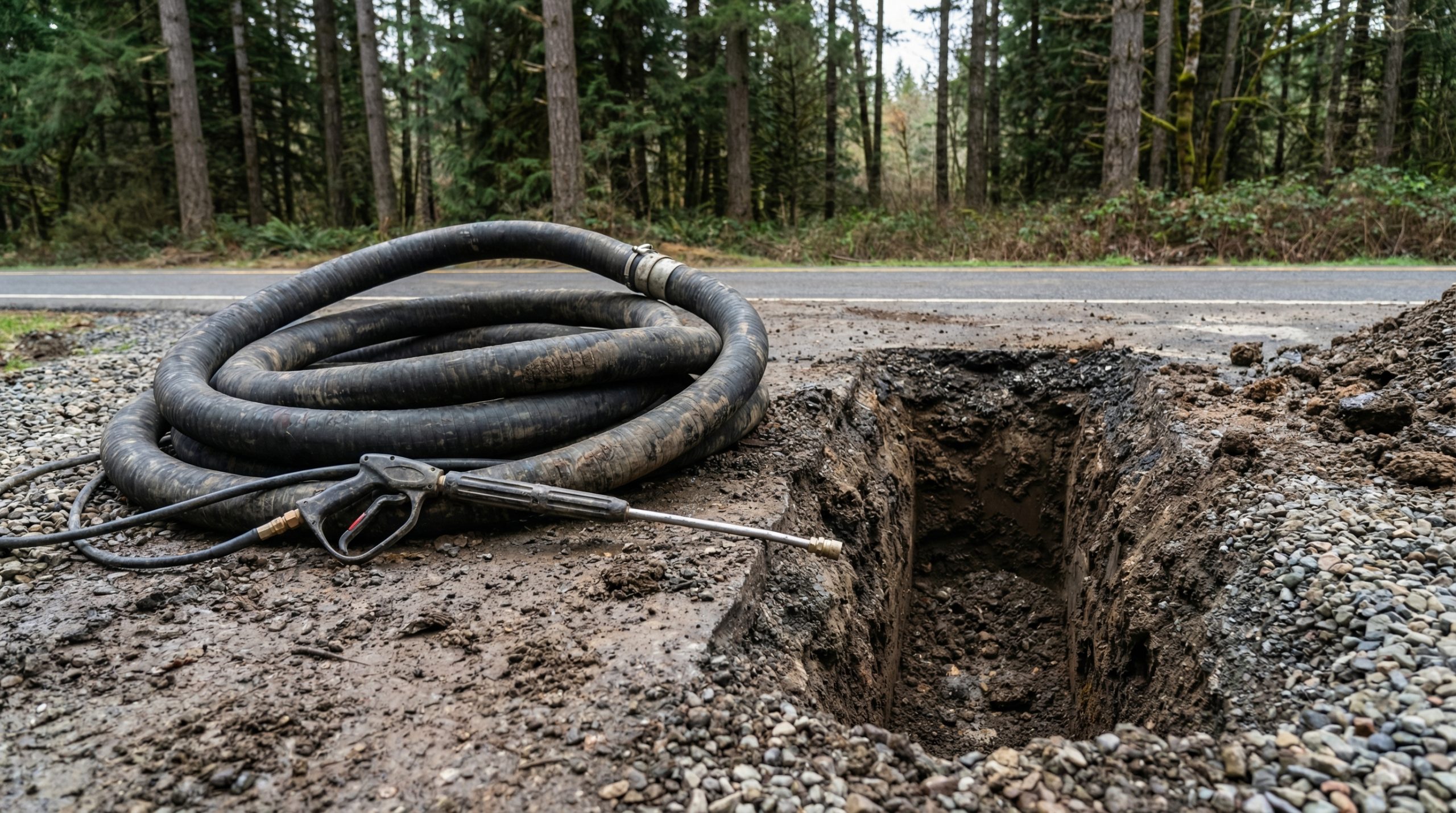
Our truck-mounted vacuum units generate over 5,000 CFM of suction paired with variable-pressure water jets configured for the hard clay and fractured basalt that characterize West Linn’s hillsides. Pressure adjusts — lower near shallow telecom conduit beneath residential driveways, maximum with rotary nozzles when cutting through Columbia River Basalt on hilltop parcels.
Extended-reach wands and angle-cut nozzles enable precision at the depths and slopes West Linn demands. Potholing on a forty-percent grade requires equipment functioning reliably at significant depth from the uphill surface.
Our Utility Exposure Process
Every West Linn potholing project follows a four-step process adapted specifically for hillside construction, landslide-sensitive soils, and the steep utility grade changes that define this community.
Step 1: Site Assessment & Locating
We review OUNC locate markings, available as-built records, and city GIS data, supplementing with electromagnetic and ground-penetrating radar scans. In West Linn, slope-adjusted utility depth is a constant concern — we note terrain grade at every pothole location and cross-reference with DOGAMI landslide hazard mapping to identify zones where excavation water or disturbed soil could contribute to slope instability.
Step 2: Safe Excavation
Test holes are created using hydro or air excavation selected for site conditions. West Linn’s heavy clay responds best to hydro excavation at moderate-to-high pressure.
Step 3: Verification
Documentation captures each utility’s depth from the uphill and downhill grade references, horizontal offset from permanent surface features, pipe material, diameter, and observable condition. GPS coordinates and photographs accompany every record.
Step 4: Backfilling & Site Cleanup
Backfill is placed in compacted lifts with attention to restoring drainage. In West Linn, pooled water above impervious basalt can trigger shallow landslides. We match fill density, restore grade, and verify drainage direction. Paved areas receive cold-patch repair.
Trusted Excavation Experts in West Linn
Prodan Construction LLC (CCB #176278) partners with general contractors, civil engineers, geotechnical consultants, and homebuilders throughout West Linn. We also provide demolition, land clearing, and retaining wall construction — services that combine naturally in a city where nearly every project involves slope management and structural earth retention.
From our Damascus facility, roughly twenty minutes via I-205, we mobilize to any West Linn neighborhood. Our crews know the city’s landslide-prone hillsides and steep streets — in West Linn, every excavation decision carries slope-stability implications.
Frequently Asked Questions About Potholing & Soft Digging in West Linn
Does potholing on a West Linn hillside increase landslide risk?
Properly executed potholing actually reduces risk by eliminating the need for large, open excavations that expose slopes to water infiltration. Our compact test holes are backfilled and compacted the same day, with drainage paths carefully restored.
How deep can vacuum excavation reach on West Linn’s steep lots?
Our equipment routinely reaches fifteen feet or more below grade. On steep West Linn lots, effective depth is measured from the uphill surface, meaning a utility that appears at eight feet on the high side may be well over ten feet deep from the downhill approach.
Is potholing required before building a retaining wall in West Linn?
West Linn’s geologic hazard overlay zones regulate development on steep slopes and often require geotechnical reporting. While potholing is not universally mandated, verifying utility positions before pouring retaining-wall footings is standard engineering practice in the city.
How quickly can Prodan schedule potholing for a West Linn project?
Standard projects are scheduled within two to three business days. Urgent requests connected to active construction or suspected utility damage can typically be accommodated within twenty-four hours. Call (503) 773-6949 to coordinate with your project timeline.
Schedule Your Utility Potholing Service in West Linn Today
West Linn’s steep terrain, landslide-sensitive geology, and constrained building sites make pre-excavation utility verification essential — not optional. Whether you are constructing a custom home above the Willamette bluffs, extending sewer service through Tanner Basin, or verifying gas-line clearance for a retaining-wall project in Bolton, Prodan Construction delivers the careful, non-destructive potholing that West Linn’s demanding landscape requires.
Call us at (503) 773-6949 or send us a message to request your free utility potholing estimate in West Linn.
Quick Links
Services
Contact Us
- Address:
20500 SE Hwy 212, Damascus, OR 97089 - Phone:
503-773-6949 - Email:
[email protected]

Oregon CCB # 176278