
- Email us at
[email protected] - Questions? Give us a call
503-773-6949
Safe Utility Potholing – Vacuum Excavation in Clackamas, OR
Non-Destructive Underground Utility Exposure in Clackamas County’s Commercial and Residential Hub
Clackamas is a community in transition. This 16,600-person unincorporated area anchored by Clackamas Town Center and flanked by Mt. Scott’s basalt slopes has been identified as needing over 5,000 additional housing units in the next two decades.
- Licensed Oregon contractor — CCB #176278 — fully bonded and insured
- Non-destructive vacuum excavation protects gas, water, electric, and telecom lines
- Serving Clackamas from Damascus, approximately 12 minutes southeast on Sunnyside Road
What Is Utility Potholing?
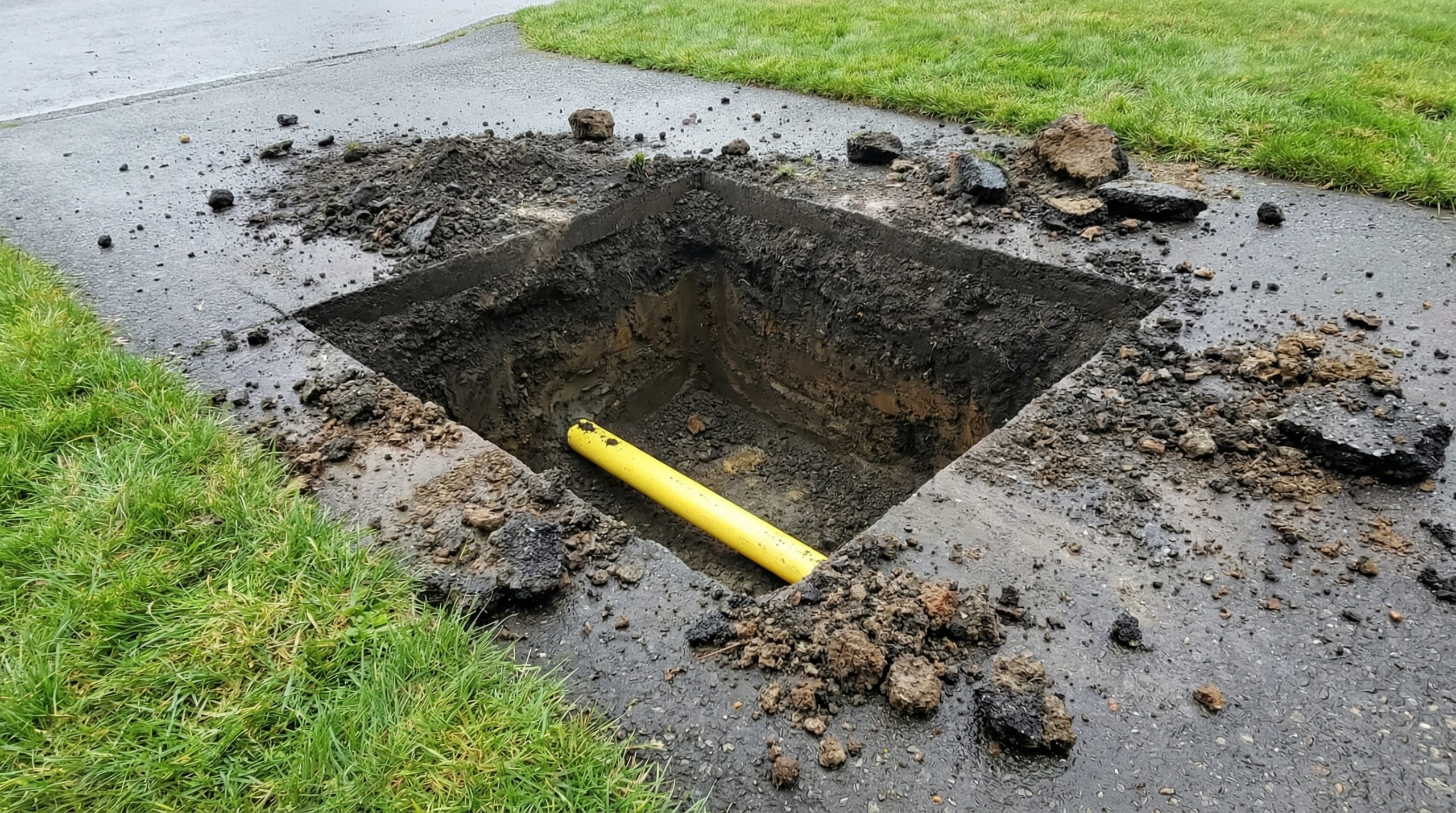
Utility potholing creates a small, deliberate opening in the ground to visually verify the exact position of buried utility infrastructure. Where traditional excavation relies on mechanical force that cannot distinguish between soil and a buried pipe, potholing uses vacuum extraction to draw material away from utilities with suction alone.
Soft digging encompasses both hydro and air vacuum excavation methods. Hydro excavation uses a pressurized water jet to break apart soil while a vacuum simultaneously collects the slurry into an onboard debris tank.
Contractors working on multi-family housing near Clackamas Town Center, commercial redevelopment along 82nd Avenue, or infrastructure upgrades in the Sunnyside corridor need verified utility positions before breaking ground. Potholing converts assumptions and decades-old as-built drawings into confirmed, measured data points that engineers can rely on for design and construction sequencing.
Potholing vs. Daylighting Utilities: What You Need to Know
These two non-destructive techniques overlap in method but differ in scope. In Clackamas, where commercial redevelopment and residential densification are occurring simultaneously, the choice between a targeted pothole and full daylighting depends on the specific engineering question being answered.
1. Targeted Utility Potholing
A targeted pothole creates a small test opening — twelve to eighteen inches across — placed directly over a suspected utility to confirm depth, material, and alignment at a single point. Along the OR-212/224 corridor, where directional drilling for telecom or gas extension must navigate beneath existing infrastructure, one or two targeted potholes provide the clearance verification that lets the bore proceed safely.
2. Utility Daylighting
Daylighting exposes a continuous run of buried utility for detailed visual inspection, condition assessment, or tie-in preparation. In the Sunnyside Road corridor, where post-war water mains and newer municipal infrastructure must interconnect for densification projects, daylighting reveals the complete picture — material transitions, depth changes, joint types, and corrosion patterns — that targeted potholes alone cannot provide.
The Benefits of Non-Destructive Excavation
Clackamas’s post-war utility grid was designed for low-density ranch homes on large lots. The coming wave of densification adds thousands of new service connections to infrastructure that already operates near capacity.
1. Damage Prevention & Safety
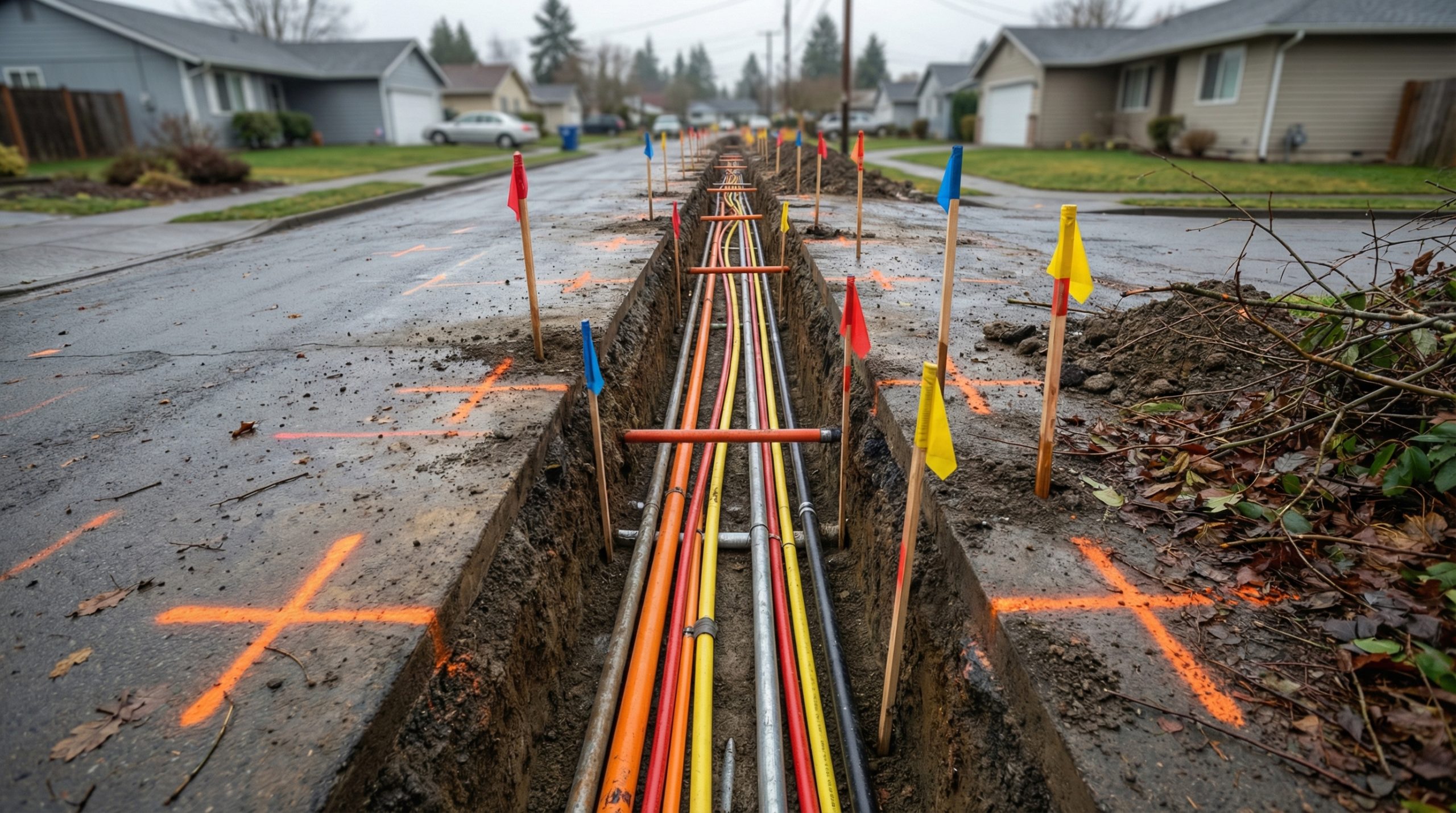
Beneath a single Clackamas residential block, you may encounter a 1950s galvanized water line, a cast-iron sewer lateral, copper gas service, coaxial cable, and fiber optic — stacked at various depths with tolerances that reflect six decades of evolving installation standards. A backhoe bucket treats all of this as undifferentiated soil.
2. Cost Savings
A single utility strike in Clackamas generates costs far beyond the repair itself. Emergency shutoffs cascade to adjacent properties. OSHA investigation stalls the project. Insurance premiums increase. Subcontractors file delay claims.
3. Precision in Tight Spaces
Clackamas presents both urban and rural access challenges. Town Center redevelopment involves working between active commercial structures with zero setback tolerance. Residential infill near Mt. Scott means tight side yards between 1960s ranch homes never designed for adjacent construction.
Our Vacuum Excavation Equipment and Methods
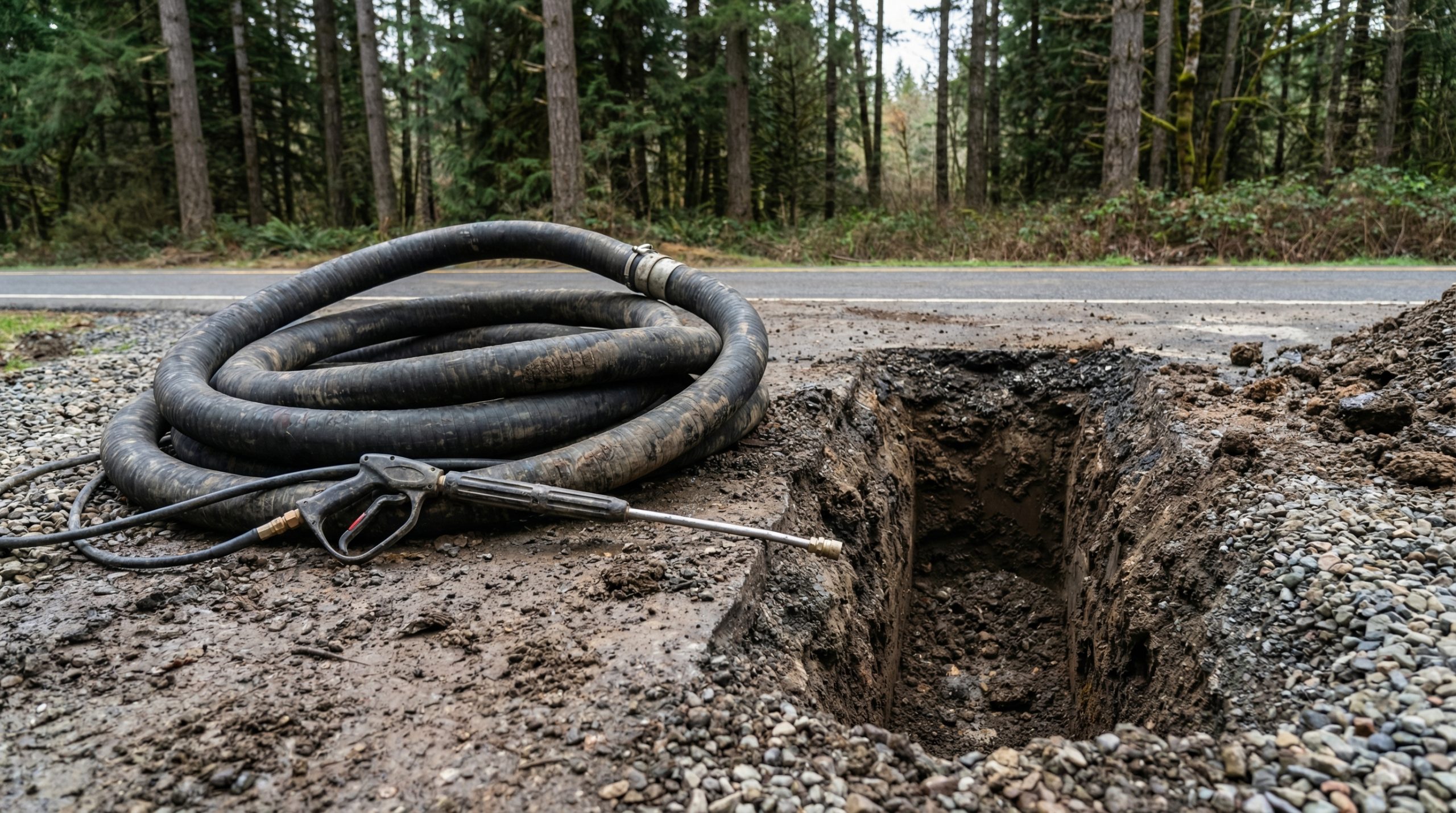
Our truck-mounted vacuum units deliver over 5,000 CFM of suction with variable water-jet pressure. In Clackamas, pressure settings shift significantly between sites — lower for soft flood silt near Johnson Creek, higher for dense basalt on Mt. Scott’s western slopes.
Extension wands and specialty nozzles enable precision work at depths exceeding twelve feet. When potholing beneath the OR-212/224 corridor or within utility easements behind commercial buildings at Clackamas Town Center, our equipment operates through compact surface openings that minimize traffic disruption and pavement restoration requirements.
Our Utility Exposure Process
Every Clackamas potholing project follows a structured four-step methodology refined for the diverse conditions found across this geologically varied community.
Step 1: Site Assessment & Locating
We review Oregon Utility Notification Center (OUNC) locate markings, municipal as-built records, and available GIS utility data. In Clackamas, where post-war infrastructure may predate digital records, we supplement standard locating with electromagnetic tracing and ground-penetrating radar.
Step 2: Safe Excavation
Test holes are created using the hydro or air method matched to local subsurface conditions. Near the I-205 corridor, soft Missoula Flood deposits excavate efficiently at moderate water pressure. On Mt. Scott’s flanks, Boring Lava basalt demands elevated pressure and rotary cutting nozzles.
Step 3: Verification
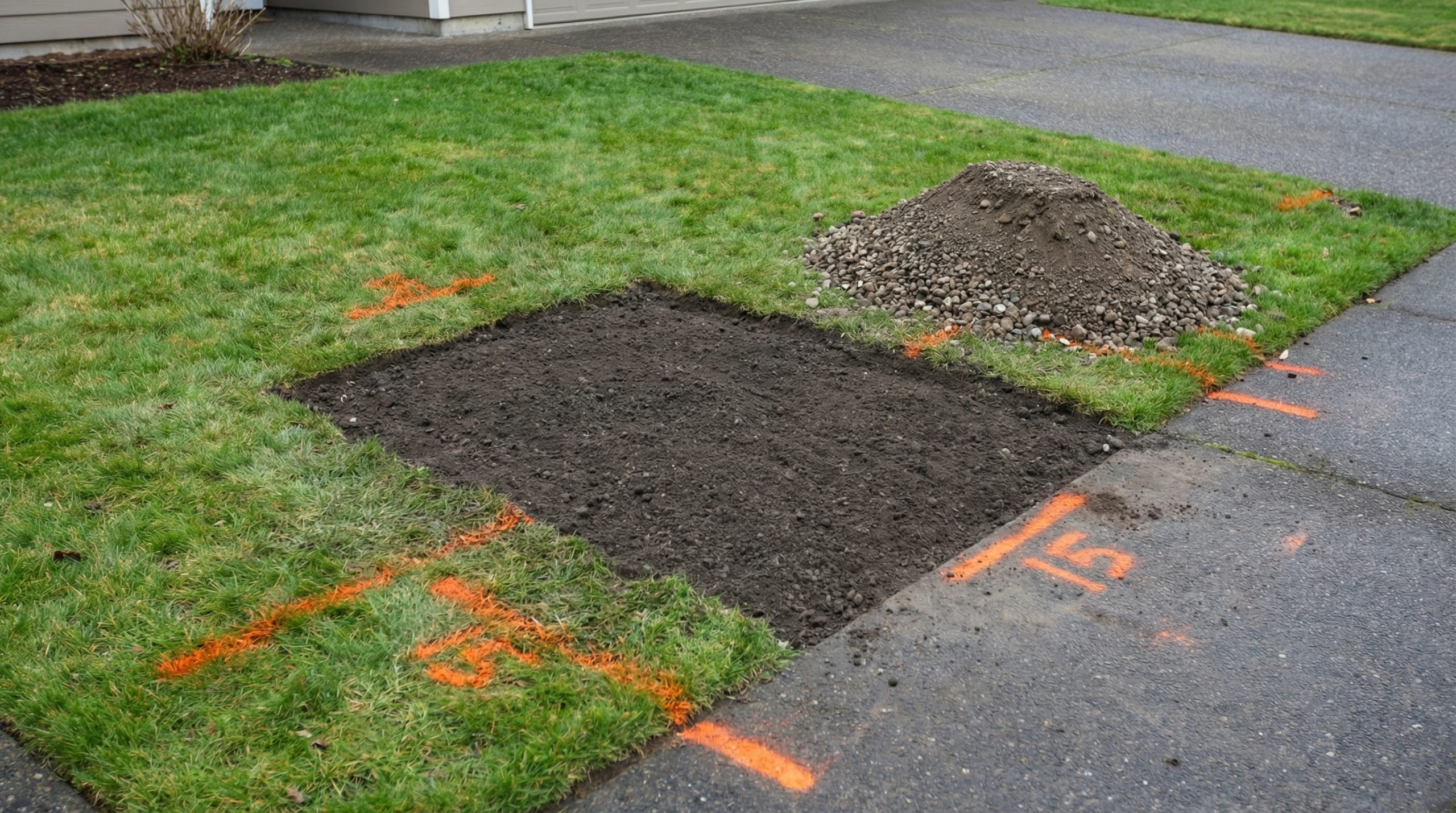
Each exposed utility is documented to engineering standards: depth below grade, horizontal distance from permanent surface features, material type, diameter, and visible condition. GPS-tagged photographs and detailed pothole logs integrate directly into project engineering drawings, Clackamas County permit packages, and utility conflict matrices for complex multi-infrastructure projects.
Step 4: Backfilling & Site Cleanup
Excavated material is backfilled in controlled lifts, compacted to restore original bearing capacity. Clackamas’s clay-heavy soils require meticulous compaction to prevent later settlement. Asphalt and concrete surfaces receive appropriate patching. Landscaping and gravel are restored.
Trusted Excavation Experts in Clackamas
Prodan Construction LLC (CCB #176278) serves general contractors, civil engineers, utility companies, and developers across Clackamas and unincorporated Clackamas County. We also provide demolition, land clearing, and retaining wall construction — comprehensive site preparation from a single local contractor.
Our Damascus headquarters is about twelve minutes from Clackamas via Sunnyside Road. Our crews work regularly in the basalt terrain near Mt. Scott, the alluvial soils along the I-205 corridor, and the commercial zones surrounding Town Center.
Frequently Asked Questions About Potholing & Soft Digging in Clackamas
How does Mt. Scott basalt affect utility potholing in Clackamas?
Mt. Scott is a Boring Lava Field volcanic butte, and basalt bedrock can appear at shallow depths on its flanks and surrounding areas. Our high-pressure hydro excavation with rotary nozzles fragments basalt effectively without transmitting damaging vibration to adjacent utilities.
Is potholing recommended before commercial redevelopment in Clackamas?
Strongly recommended. Commercial zones along I-205, OR-212/224, and 82nd Avenue carry dense utility infrastructure accumulated over decades of development. Potholing verifies the actual positions of gas, water, sewer, electrical, and telecom lines before excavation begins.
What types of utilities can vacuum excavation expose?
Our equipment safely exposes all buried utility types: natural gas mains and service lines, water mains and laterals, sanitary and storm sewer pipes, electrical conduit, fiber optic cable, coaxial cable, and irrigation lines. Both metallic and non-metallic utilities are located and documented.
How do I schedule potholing for a Clackamas construction project?
Call us at (503) 773-6949 or submit a request through our website. Standard projects in Clackamas are typically scheduled within one to three business days, depending on scope.
Schedule Your Utility Potholing Service in Clackamas Today
Clackamas is building its next chapter. Whether you are densifying residential neighborhoods near Mt.
Call us at (503) 773-6949 or send us a message to request your free utility potholing estimate in Clackamas.
Quick Links
Services
Contact Us
- Address:
20500 SE Hwy 212, Damascus, OR 97089 - Phone:
503-773-6949 - Email:
[email protected]

Oregon CCB # 176278